
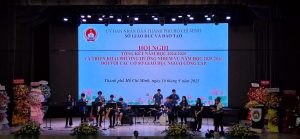
At the conference to summarize the 2024-2025 school year and deploy tasks for the 2025-2026 school year organized by the Department of Education and Training of Ho Chi Minh City on the morning of August 27, Deputy Secretary of the City Party Committee, Chairman of the People's Council of Ho Chi Minh City Vo Van Minh requested the education sector to have specific solutions to overcome difficulties in the new school year.
Accordingly, in addition to continuing the roadmap and ensuring the completion of breakthrough programs and projects in the education sector, the entire sector needs to promote the application of information technology in management and teaching, ensuring that technical infrastructure, management software and online learning platforms are deployed effectively and safely.
In particular, continue to focus on studying and following Ho Chi Minh's ideology, morality and lifestyle in conjunction with building a "Happy School".
The Department of Education and Training of Ho Chi Minh City focuses on researching and proposing solutions for training and fostering a team of teachers to meet the requirements of educational innovation. At the same time, recruitment must ensure quality, with priority given to preschool and primary schools, and there must be regulation between facilities to overcome local shortages and surpluses; pay attention to and propose policies to attract, create resources and ensure conditions for teachers to work with peace of mind for the long term.
“In the coming time, the city will continue to pay attention to and create conditions for the development of the education sector, and propose action programs to build the city into an open learning environment, where all citizens have the opportunity to study, develop knowledge and skills to adapt and develop in the digital age,” Mr. Vo Van Minh emphasized.
Also at the conference, Deputy Minister of Education and Training Pham Ngoc Thuong affirmed that in the past school year, the Ho Chi Minh City Education and Training sector achieved many outstanding results.
In particular, the entire industry has transformed its operating status very quickly and promptly after the merger and operation of the two-level government model, most clearly demonstrated in the fact that the high school graduation exam was organized on a large scale when implementing a three-level government, but when the exam was graded by a two-level government, it still took place very smoothly, safely and on time.
The quality of education at all levels from preschool, general education to vocational education and continuing education has changed positively, higher than the previous school year; entrance exams and graduation exams are organized seriously, publicly and transparently. The high school graduation rate reached 99,86%, higher than the national average.
Along with that, 100% educational institutions achieved universal education for 5-year-old children, 100% achieved universal secondary and high school level 3, 100% achieved illiteracy eradication standards. The education sector promptly paid attention to disadvantaged students and integrated students in many forms, even in industrial zones where the number of students increased rapidly, there were still enough places to study.
Digitalization work has been strongly deployed with 100 digital schools, 164 digital transformation models and an educational geographic data information system.
The “Happy School” pioneered by Ho Chi Minh City has been implemented with specific, practical criteria and brought high efficiency. The teaching staff has been trained and improved their management and professional capacity.
English teaching and learning continues to be promoted, helping the city maintain its leading position in the high school graduation exam.
The tradition of physical education in Ho Chi Minh City has been strongly and vigorously promoted. Ho Chi Minh City has continuously ranked first in the country in student sports achievements for the past 10 years.
Besides the achieved results, Deputy Minister Pham Ngoc Thuong said that the education and training sector of Ho Chi Minh City still faces many difficulties and limitations.
Specifically, school facilities have not met the needs, especially after the merger. There are schools with more than 100 classes, causing overload for management and affecting the quality of teaching. The teaching staff is still lacking in quantity, not uniform in quality, and does not fully meet the requirements of the 2019 Education Law.
In the new school year, the Deputy Minister requested that management levels continue to pay attention to reviewing and planning the school system. At the same time, pay attention to non-public educational institutions, independent private kindergartens and facilities with foreign elements.
The implementation of the two-tier government model poses new requirements, including amending Circular 29 on extra teaching and learning accordingly. The consistent principle is to limit the widespread situation of extra teaching and learning, eliminating students' ability to self-study.
Educational management needs to continue to be strongly innovated, shifting from administrative thinking to creative and promoting thinking. Teaching methods need to continue to be innovated, focusing on forming self-study capacity and developing comprehensive qualities and abilities for students.
In particular, the city's education sector needs to aim at training Vietnamese citizens to become global citizens, capable of international integration, while maintaining close coordination between family, school and society to ensure the quality of education.


 English
  Vietnamese